AI Documentation Toolkits

Free Ebook
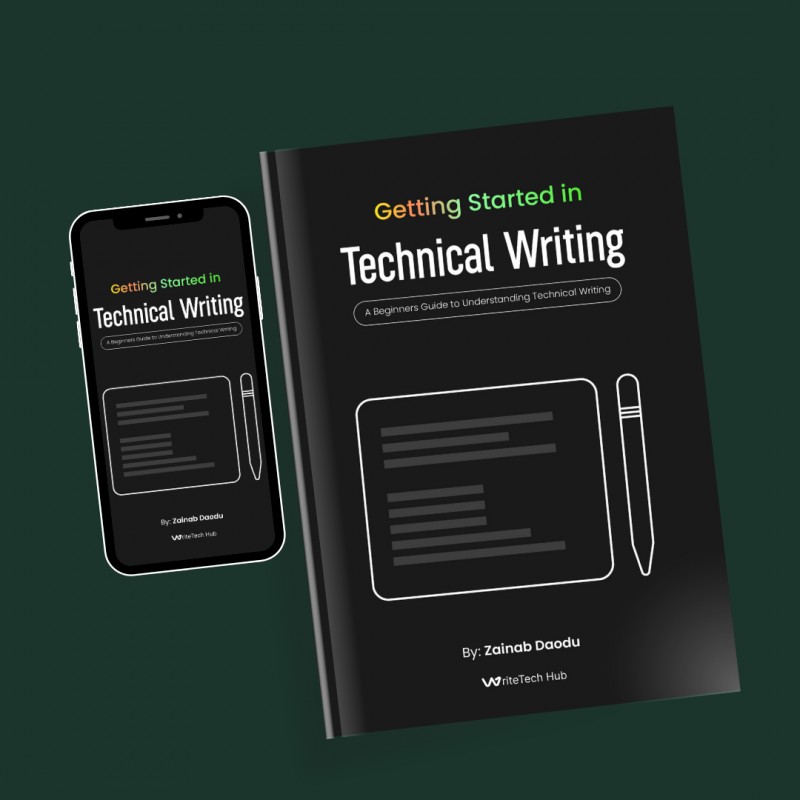
Getting Started in Technical Writing ebook cover

Getting Started in Technical Writing

For people exploring technical writing as a career or trying to get their first role.

A practical guide to breaking into technical writing: what the role actually involves, the tools you need to know, how to build a portfolio with no work experience, and how to land your first job.

Get the Ebook →
Free · For individual writers

The AI Docs Playbook

Practical AI workflows for technical writers who want a more consistent documentation process.

Five reusable workflows based on documentation work. They work with ChatGPT, Claude, Gemini, and other AI assistants.

What's inside

  • Set up an AI assistant with the right documentation context so it works based on your standards instead of making assumptions.
  • Turn support conversations into clear, actionable documentation tasks.
  • Draft documentation from screenshots while identifying details that still need to be verified.
  • Run a copy edit that checks your documentation against your style guide without rewriting your voice.
  • Create or restructure documentation pages using established documentation patterns.
Free · For senior writers & teams

The AI Documentation Pipeline

For technical writers and documentation leads working in git-based repositories who want consistent AI workflows across a team.

A three-layer system that brings AI into the documentation workflow, from planning and drafting to review and release. It lives in your repository so the process stays consistent as your team grows.

What's inside

  • Skills layer: reusable AI workflows for research, planning, drafting, reviewing, and publishing documentation.
  • Editor prompts: lightweight instructions for content reviews, terminology checks, and documentation audits.
  • CI automation: automated checks with Vale prose linting and AI-generated pull request summaries.
  • Project instruction file pattern: a way to give AI tools consistent repository-specific guidance.
  • Setup guides for Claude Code, Cursor, and Windsurf, plus guidance for adapting the workflow to your own stack.
Free · For multilingual teams

The AI Translation Pipeline

For teams maintaining documentation in multiple languages who want a more reliable translation workflow.

A structured system for translating documentation with change detection, glossary management, and human review built into the process. It helps teams automate repetitive translation work while keeping control over terminology and quality.

What's inside

  • Translation script with change detection: translates only the content that has changed since the last run.
  • CI workflow: creates translation updates in a separate branch and opens a pull request for human review.
  • Three-layer glossary system: manages terminology at the global, folder, and file levels.
  • Review guide: helps reviewers identify common AI translation issues and check for accuracy before publishing.

Requires: Git-based doc repository · GitHub Actions · Python 3.x · OpenAI API key (or any translation API)

Free · For docs teams & leads

The AI-Ready Documentation Framework

For documentation leads and teams preparing their docs for AI tools, including coding agents, copilots, and RAG systems.

A seven-phase framework for improving how AI tools discover, read, and use documentation. It covers benchmarking, machine-readable delivery, content structure, agent instruction files, AI-assisted workflows, maintenance, and measurement. Includes a real-world case study showing how one team improved their benchmark score from the high 50s to the mid-70s.

What's inside

  • The seven-phase framework: baseline benchmarking, machine-readable delivery, page structure improvements, agent instruction files, AI-assisted contribution workflows, maintenance, and measurement.
  • How to create and automate llms.txt and llms-full.txt, with setup guidance for Docusaurus, MkDocs, Sphinx, Read the Docs, and GitBook.
  • The reference-table pattern for converting configuration documentation from paragraphs into structured content that AI tools can extract more easily.
  • An AGENTS.md template with guidance on writing useful instructions and deciding what belongs in the file.
  • A companion case study showing how one team measured problems, prioritized fixes, and decided which changes were worth building.
On Hashnode Technical writing · Documentation standards
See all →
Research in Technical Writing: Essential Tips for Success
Technical Writing October 2023

Research in Technical Writing: Essential Tips for Success

Research is one of the most sought-after skills for technical writers. This covers how to conduct thorough research, identify reliable sources, and organise your findings for accurate, high-quality documentation.

Read article →
Getting Started with UX Writing
UX Writing September 2023

Getting Started with UX Writing

UX writing shapes how users experience products. This covers the principles, techniques, and practical skills you need to write microcopy that guides users through interfaces clearly and confidently.

Read article →
Style Guides in Technical Writing
Documentation Standards September 2023

Style Guides in Technical Writing

Style guides are one of the most important tools in a technical writer's toolkit. This covers what they are, why they matter, and how to use them to produce consistent, professional documentation.

Read article →
Search Engine Optimization in Technical Writing
SEO July 2023

Search Engine Optimization in Technical Writing

SEO isn't just for marketing — it's essential for documentation too. This covers how to apply SEO principles to technical content so the right readers find what they need, faster.

Read article →
Docs as Code: A Beginner's Guide
Doc Ops May 2023

Docs as Code: A Beginner's Guide

Docs as Code brings software engineering practices — version control, CI/CD, and code review — to documentation workflows. This guide walks you through the tooling, philosophy, and setup from scratch.

Read article →
The Role of Documentation in Software Engineering
Technical Writing April 2023

The Role of Documentation in Software Engineering

Documentation is infrastructure, not an afterthought. This explores how effective docs accelerate onboarding, reduce support load, and become a competitive advantage for engineering teams.

Read article →
A Technical Writer's Guide to Contributing to Open Source
Open Source March 2023

A Technical Writer's Guide to Contributing to Open Source

Open source is not just for engineers. This guide shows technical writers how to find projects that need documentation help, make their first contribution, and build a portfolio through community work.

Read article →
Audience Analysis in Technical Writing
Technical Writing February 2023

Audience Analysis in Technical Writing

Writing for the wrong audience is one of the most common documentation failures. This covers how to identify, research, and adapt your writing for the people who will actually use what you create.

Read article →
On Medium API documentation · DevOps · Developer tools
See all →

Ready to fix your documentation?

Whether you need a senior writer, a documentation strategy, or a consultant. Let's talk.